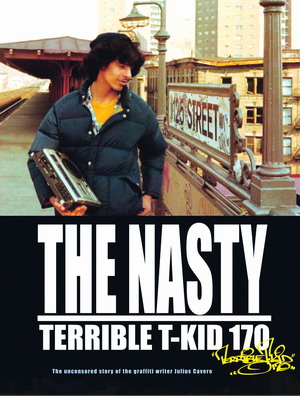
The
Nasty "Terrible" T-KID 170 is the autobiography of graffiti
writer Julius Cavero aka T-KID 170.
This autobiography chronicles the life of a gang member, turned graffiti
artist and style mentor for urban youth—the uncensored Bronx hip-hop
story. During a gang shoot-out in a local park, Julius Cavero suffered
three shots to the leg, one nearly severing his major artery. Left for
dead, by gang rivals and so-called comrades; T-Kid survived the ordeal
only to come face-to-face with 3 weeks of intensive surgical procedures.
In
those three weeks, Julius Cavero sketched, endlessly. It was there that
he chose to become T-KID 170—T for the tall and skinny look he
had, and KID just because that’s what so many people called him.
At that moment, Julius Cavero gave up gang life for a new vocation.
T-Kid would now focus on art, specifically street art: GRAFFITTI.
The
Nasty "Terrible" T-KID 170 retraces his life from the early
1960s to 2005 through his written accounts and artwork, including images
of painted trains, walls, canvases, drawings, and sketches produced
over the last thirty years. Few artists today can tell a tale like T-KID’s—a
ghetto childhood, gangbanging, and daring feats of graffiti. Many who
lived in such times either left their lives or their art behind. T-KID,
who won fame early on, lived to tell the tale and withstood the test
of time.
A
time - journey through the life of T-KID, the wild era of New York and
the beginning of the graffiti and hip hop culture in the South Bronx.
"Very
few writers survived the voyage from gangs to Hip Hop, as we now know
it. Those who did, carry hard earned patches and metals of honor fastened
on their hearts. These highly decorated soldiers are human embodiments
of today’s most influential cultural movement. They carry the
history and legacy of countless warriors. From this long line of folk
heroes came the notorious Terrible T-Kid 170, one of The Nastiest Boyz
on the scene."
PopMaster Fabel
"I
think T-Kid was a major stylist in New York in the early 1980’s
and an important voice. He pushed the envelope very far although his
work is still very close to graffiti. People where blown away by how
avant-garde he was in the graffiti scene. He is still a big influence
around the world."
Henry Chalfant